AI Video Model Comparison 2026: The Complete Technical Breakdown
Runway Gen-4.5 vs OpenAI Sora 2 vs Google Veo 3.1 vs LTX-2 vs Wan 2.6 vs Seedance 2.0 vs Kling. Which model wins for your use case?
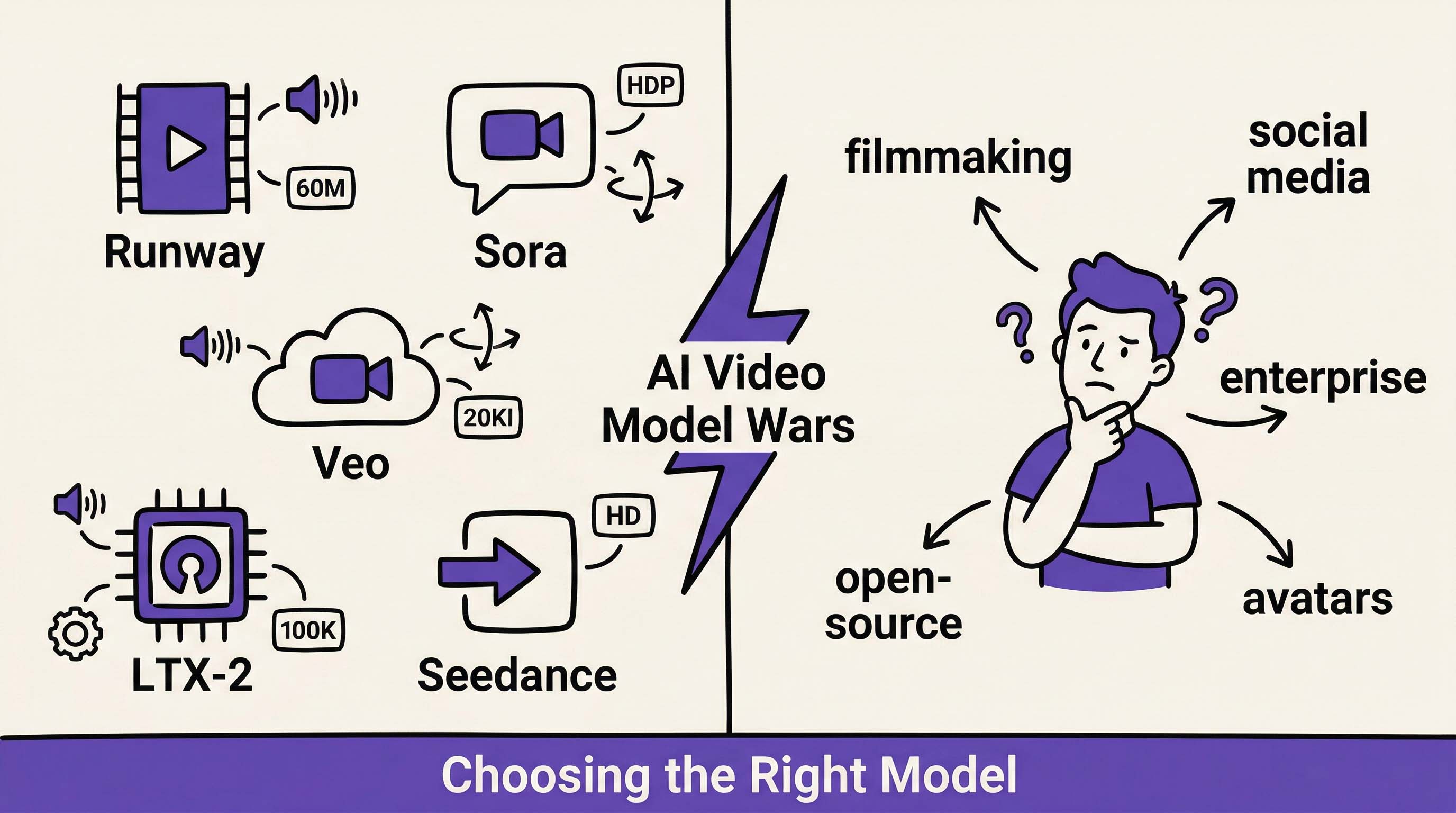 The AI video race now has many models—but the best one depends entirely on your use case. Illustration created with RizzGen.
The AI video generation landscape shifted dramatically between October 2025 and February 2026. Seven major models now compete for dominance, each with distinct architectural advantages. Runway Gen-4.5 claims the benchmark crown. Google Veo 3.1 introduced native audio that changed the game. OpenAI Sora 2 finally reached public hands. LTX-2 went fully open-source. Wan 2.6 and Seedance 2.0 emerged from China with multimodal capabilities that challenge Western counterparts.
If you are building a product, producing content, or investing in AI infrastructure, you need to know which model actually delivers. Here is the technical reality of each platform as of February 2026.
Executive Summary: Quick Comparison Table
| Model | Developer | Max Duration | Resolution | Native Audio | Price/Second | Open Source |
|---|---|---|---|---|---|---|
| Runway Gen-4.5 | Runway | 60s | 1080p | Yes (Updated) | ~$0.20-0.50 | No |
| OpenAI Sora 2 | OpenAI | 20s | 1080p | Yes | ~$0.10-0.50 | No |
| Google Veo 3.1 | Google DeepMind | 60s | 1080p | Yes | $0.15-0.40 | No |
| LTX-2 | Lightricks | 10s | 4K | Yes | $0.04-0.16 | Yes |
| Wan 2.6 | Alibaba | 15s | 1080p | Yes | Free/API | Partial |
| Seedance 2.0 | ByteDance | 15s | 2K (2048p) | Yes | $0.15-0.35 | No |
| Kling 3.0 | Kuaishou | 15s | 1080p | No | Credit-based | No |
1. Runway Gen-4.5 (December 2025)
Runway Gen-4.5 currently holds the top position on the Artificial Analysis Text-to-Video benchmark with 1,247 Elo points, surpassing Google and OpenAI. Released December 1, 2025, it represents an iterative but substantial upgrade from Gen-4.
Key Specifications
- Max Duration: 60 seconds (extended via updated model)
- Resolution: 1080p HD
- Frame Rate: Up to 60 fps
- Native Audio: Added in December 2025 update (previously visual-only)
- Architecture: Diffusion transformer optimized on NVIDIA Hopper/Blackwell GPUs
Strengths
Physical Accuracy: Gen-4.5 excels at realistic physics - objects move with proper weight, momentum, and fluid dynamics. Liquids flow naturally. Fabric and hair maintain coherence across frames.
Character Consistency: Best-in-class for maintaining character appearance across scenes without fine-tuning. Uses reference images to lock subjects across different lighting and camera angles.
Prompt Adherence: Superior instruction-following. Complex camera movements ("dolly zoom," "whip pan," "tracking shot") execute reliably.
Limitations
- Causal reasoning errors (effects sometimes precede causes)
- Object permanence issues in complex scenes
- Premium pricing compared to open-source alternatives
Best For
Professional filmmakers, advertising agencies, and production studios requiring cinematic quality with precise camera control. The motion quality beats competitors for high-end commercial work.
2. OpenAI Sora 2 (September 2025)
Sora 2 launched September 30, 2025, alongside an iOS app featuring TikTok-style social features. It emphasizes physical world simulation and narrative continuity.
Key Specifications
- Max Duration: 20 seconds (up to 60s with extensions)
- Resolution: 1080p
- Native Audio: Yes (dialogue, sound effects, ambient)
- Availability: US/Canada only, invite-based rollout
- Watermark: Visible moving watermark (removable by third-party tools)
Strengths
Physical Realism: Strong adherence to real-world physics. Fewer "magical morphs" than competitors. Objects interact with believable weight and collision.
Audio Synchronization: Native audio generation including synchronized dialogue and environmental sounds. Lip-sync quality leads the market.
Narrative Continuity: Better than competitors at maintaining story coherence across sequences. Designed for short-form narrative content.
Limitations
- Limited availability (US/Canada only, invite required)
- Multi-shot consistency still imperfect for complex narratives
- Strict safety guardrails restrict creative use cases
- Text rendering and hand articulation remain weak points
Best For
Social media content creators, short-form storytellers, and概念验证 filmmakers exploring AI-native narratives. The mobile app integration makes it ideal for rapid iteration on viral content concepts.
3. Google Veo 3.1 (October 2025)
Google released Veo 3.1 on October 14, 2025, building on Veo 3's native audio capabilities. Available through Gemini, Flow, and Vertex AI.
Key Specifications
- Max Duration: 60 seconds (extendable)
- Resolution: 1080p HD
- Frame Rates: 24, 30, 60 fps
- Native Audio: Full audio generation (dialogue, SFX, ambient)
- Aspect Ratios: 16:9 and 9:16
- Pricing: $0.15/s (Fast), $0.40/s (Standard)
Strengths
Audio Quality: Industry-leading native audio. Environmental sounds, dialogue, and music synchronize perfectly with visuals. Described by DeepMind CEO Demis Hassabis as "the moment AI video left the silent film era."
Flow Integration: Deep integration with Google's Flow editor enables "Ingredients to Video," "Frames to Video," and advanced editing (Insert/Remove objects).
Enterprise Access: Strongest enterprise deployment through Vertex AI with volume pricing and compliance controls.
Limitations
- Shorter maximum duration than Runway (60s vs effective longer via extensions)
- Character consistency weaker than Runway Gen-4.5
- Requires Google ecosystem adoption for best experience
Best For
Enterprise marketing teams, YouTube creators, and brands already in the Google ecosystem. The audio generation is unmatched for dialogue-heavy content.
4. LTX-2 (October 2025)
Lightricks released LTX-2 on October 23, 2025, as the first complete open-source audio-video foundation model. A game-changer for developers and self-hosters.
Key Specifications
- Max Duration: 10 seconds (up to 60s with extensions in v0.9.8)
- Resolution: Up to 4K at 50 fps
- Native Audio: Yes (simultaneous audio-video generation)
- License: Open weights (BF16 and NVFP8 quantized)
- Hardware: Runs on consumer GPUs (RTX 4090)
Strengths
Open Source: Full model weights available. Customizable, fine-tunable, and deployable on-premise. No API dependency or vendor lock-in.
4K Resolution: Highest resolution output among all models. True 4K at 50 fps for broadcast-quality production.
Cost Efficiency: 50% lower compute cost than competitors. Fast mode starts at $0.04/second.
Multi-keyframe Control: Precise control via keyframe conditioning, camera LoRAs, and depth/pose IC-LoRAs.
Limitations
- Shorter base duration (10s) compared to competitors
- Requires technical expertise to self-host
- Temporal consistency weaker than Runway/Seedance for long sequences
Best For
Developers, technical artists, and studios requiring data privacy (on-premise deployment) or 4K output. The open architecture makes it ideal for research and custom pipelines.
5. Wan 2.6 (December 2025)
Alibaba's Wan 2.6 series, unveiled December 16, 2025, introduces China's first reference-to-video model with multimodal inputs and strong performance on the VBench benchmark (84.7%).
Key Specifications
- Max Duration: 15 seconds
- Resolution: 1080p
- Native Audio: Yes (audio-visual synchronization)
- Multilingual: English, Chinese (including dialects), Japanese, Korean, Spanish
- Reference Input: Video + voice cloning (R2V model)
Strengths
Reference-to-Video (R2V): Upload a character video with voice, then generate new scenes starring that person. Maintains consistent appearance and voice across generated content.
Multilingual Lip-Sync: Superior handling of Chinese dialects (Sichuan, Shaanxi) and multilingual dialogue with accurate lip synchronization.
Accessibility: Free tier available through Qwen App and Alibaba Cloud. Lowest barrier to entry for experimentation.
Limitations
- Availability primarily in Asia (though accessible globally)
- Shorter max duration than Western competitors
- Documentation and support primarily in Chinese
Best For
Chinese content creators, short-form drama producers, and developers needing multilingual video generation. The R2V capability is unique for personal avatars.
6. Seedance 2.0 (February 2026)
ByteDance released Seedance 2.0 in February 2026, featuring true multimodal inputs (up to 12 files) and director-level control through natural language @ mentions.
Key Specifications
- Max Duration: 15 seconds (extendable)
- Resolution: 2K (2048p)
- Native Audio: Yes (synchronized sound effects and music)
- Multimodal Inputs: Up to 9 images, 3 videos (15s total), 3 audio files (15s total), plus text
- Aspect Ratios: 16:9, 4:3, 1:1, 3:4, 9:16
Strengths
@ Mention System: Unique reference syntax: "@Image1 for character, @Video1 for camera motion, @Audio1 for rhythm." Unprecedented control over how each input influences output.
Camera Replication: Upload any reference video and replicate its exact camera movements - tracking shots, Hitchcock zooms, one-takes. Revolutionary for cinematographers.
Video Editing: Can modify existing videos without full regeneration. Replace characters, extend scenes, or adjust timing iteratively.
Limitations
- No photorealistic human face uploads (compliance restriction)
- Shorter base duration than Runway/Veo
- Requires learning @ mention syntax for full control
Best For
Music video producers, brand campaigns requiring precise visual consistency, and filmmakers who think in terms of references rather than prompts. The camera replication is unmatched.
7. Kling 3.0 (Avatar 2.0 Released November 2025)
Kuaishou's Kling AI released Avatar 2.0 in November 2025, with significant improvements to motion quality and the introduction of 5-minute video generation for avatars.
Key Specifications
- Max Duration: 5 minutes (for avatars), 15 seconds (standard generation)
- Resolution: 1080p
- Native Audio: No (visual generation only)
- Specialty: AI Avatar generation with expressions and gestures
- Hand Movement: Major improvements in v2.0
Strengths
Avatar Performance: Industry-leading AI avatar generation. 5-minute continuous video with consistent expressions, gestures, and lip-sync for virtual presenters.
Motion Brush: Intuitive motion control by painting movement directions on frames.
Affordability: Most cost-effective option for high-volume generation.
Limitations
- No native audio generation
- Focused on avatar/character content rather than general video
- Character consistency good but not Runway-level for complex narratives
Best For
Virtual influencers, educational content creators, and companies needing long-form avatar presentations. The 5-minute duration is unique for talking-head content.
Performance Benchmarks
Based on Artificial Analysis Elo ratings and VBench scores:
| Model | Artificial Analysis Elo | VBench Score | Motion Quality | Consistency |
|---|---|---|---|---|
| Runway Gen-4.5 | 1,247 (#1) | - | Excellent | Excellent |
| Google Veo 3.1 | #2 | - | Very Good | Good |
| LTX-2 | - | 6.18/10 | Good | Moderate |
| Wan 2.6 | - | 84.7% | Very Good | Good |
| OpenAI Sora 2 | #7 | - | Very Good | Good |
Use Case Recommendations
Choose Runway Gen-4.5 If...
- You need cinematic motion quality for commercial production
- Character consistency across multiple scenes is critical
- You require precise camera control (dolly zooms, tracking shots)
- Budget allows for premium pricing ($0.20-0.50/s)
Choose OpenAI Sora 2 If...
- You create short-form narrative content for social media
- Native audio/dialogue synchronization is priority
- You want TikTok-style app integration for rapid iteration
- You are in US/Canada and have access
Choose Google Veo 3.1 If...
- You need enterprise-grade deployment and compliance
- You are already using Google Workspace/Cloud infrastructure
- Audio generation quality is critical (best-in-class)
- You need 60-second continuous generation
Choose LTX-2 If...
- You require 4K resolution output
- You need on-premise deployment (data privacy)
- You want to fine-tune or customize the model
- You have technical expertise to self-host
Choose Wan 2.6 If...
- You create content in Chinese or need multilingual support
- You want reference-to-video with voice cloning
- Budget is constrained (free tier available)
- You need R2V (reference video) capabilities
Choose Seedance 2.0 If...
- You think in visual references rather than text prompts
- You need to replicate specific camera movements from reference footage
- You create music videos (audio rhythm synchronization)
- You want iterative video editing without regeneration
Choose Kling 3.0 If...
- You need long-form avatar presentations (5 minutes)
- You create educational or corporate training content
- You want the most affordable high-volume option
- Native audio is not required (you will add voiceover separately)
Integration with RizzGen
RizzGen integrates Runway Gen-4.5, Kling, and Veo as backend generation engines while adding our scene-based control layer. This means:
- You get Runway's motion quality with RizzGen's character locking
- You get Kling's affordability with RizzGen's multi-scene consistency
- You get Veo's audio with RizzGen's template architecture
We do not replace these models. We make them controllable for production workflows.
Use the Best Models with Scene-Based Control
RizzGen integrates leading AI video models and adds the consistency layer they are missing.
FAQ
Which model has the best character consistency?
Runway Gen-4.5 leads for character consistency across scenes, followed by Seedance 2.0 for single-scene reference adherence. For long-form avatar consistency, Kling 3.0's 5-minute generation is unmatched.
Which is the cheapest for high-volume generation?
LTX-2 at $0.04/second (Fast mode) or Wan 2.6 (free tier). For commercial use, Kling offers the best credit-based pricing for volume.
Can I use these models commercially?
Runway, Veo, Sora, and Seedance allow commercial use on paid tiers. LTX-2 is fully open-source (check license). Wan 2.6 allows commercial use but check Alibaba's terms for your region.
Which has the best native audio?
Google Veo 3.1 leads for audio quality and synchronization, followed by Sora 2. Runway added audio in December 2025. LTX-2 and Seedance also generate audio.
What about 4K video?
Only LTX-2 offers true 4K generation (up to 50 fps). Runway, Veo, and others max out at 1080p currently.